Designing the leasing journey in an AI-native real estate operations platform
Leasing has always been a people-heavy business. Every day, leasing teams answer the same questions, schedule tours, follow up with prospects, and keep conversations moving across text, email, and phone.
At Accolade, we set out to build an AI-native platform that could take on much of this operational work, allowing leasing teams to step in only when human judgment was needed. Instead of adding AI to an existing product, we were designing the experience around AI from day one.
In 2025, I joined Accolade as one of the founding Product Designers and spent the next year and a half helping shape the first version of the platform alongside Product Managers, engineers, AI teams, and business stakeholders. Beyond designing the experience, I helped define workflows, co-authored PRDs, evolved our design system, and turned evolving product ideas into an MVP.


Learning a new domain
Before designing, I had to understand how leasing teams actually manage prospects, tours, applications, and conversations. Instead of jumping into screens, I spent time mapping workflows across competitors, existing systems, and discussions with PMs and engineers.
It took us months to get it right
Leasing is a high-volume operational workflow. Agents don't manage one prospect at a time. They manage hundreds.
A prospect could arrive from Zillow, Apartments.com, a property microsite, or a phone call. AI gathered information, answered common questions, scheduled tours, updated centralized guest cards, and maintained conversation history across channels. Human agents entered only when AI couldn't confidently resolve the request.
Designing this meant thinking beyond individual screens. I had to understand how information moved through the system, how agents prioritized work, and how AI and humans shared responsibility without creating friction.


Defining the product as we built it
Since the product was built from 0 to 1, many problems had no existing patterns to follow.
I worked with stakeholders to understand leasing operations, mapped user journeys, wrote detailed PRDs, explored multiple product directions, and continuously refined requirements before moving into design. Every feature balanced business goals, engineering effort, and the realities of how leasing teams actually worked.
As the product matured, so did the way we worked. We started by exploring ideas in Figma and reviewing concepts with stakeholders. Later, we began using Claude to quickly prototype multiple directions, gather feedback much earlier, and refine both the designs and PRDs as we learned. It helped us move faster without skipping the thinking behind each decision.
Rather than designing every possible feature, we focused on delivering a strong MVP that could validate assumptions quickly while creating a flexible foundation for future modules.

Research beyond our product
One of the most valuable parts of the project was understanding how AI was changing leasing.
I spent months studying leading AI-first products in the space, including EliseAI, one of the top 50 AI companies (Our biggest competitor) transforming property management. I focused on understanding product strategy, AI handoff patterns, operational workflows, and how successful products balanced automation with human intervention.
These insights influenced many product discussions, helping the team make more informed decisions while building something that fit our own vision.

Constraints worth designing for
Building an AI-native leasing platform came with its own set of challenges.
Designing an MVP. We had far more ideas than we could build in the first release. Every feature had to earn its place. We constantly asked whether it solved the core leasing journey or simply added complexity, removing anything that didn't move the product forward.
Understanding the market. Before designing solutions, we spent months learning how leasing teams actually worked. We studied leasing workflows, support documentation, existing CRM products, and platforms like EliseAI, one of the leading AI companies in the real estate space. The goal wasn't to copy competitors, but to understand the problem well enough to build something better.
Working with connected systems. The platform didn't exist on its own. It had to work alongside Property Management Systems (PMS), telephony providers, email services, and other backend systems. Many design decisions came from understanding how information moved across these systems, not just what appeared on a screen.
Finding clarity through iteration. Some of our biggest workflows changed several times before they felt right. We revisited ideas throughout the year, refining them through discussions with Product Managers, engineers, AI teams, and stakeholders. Each iteration helped remove assumptions and brought the product closer to how leasing teams actually worked.
Outcomes
Although the platform was still in its MVP stage, the work established the foundation for a much larger vision.
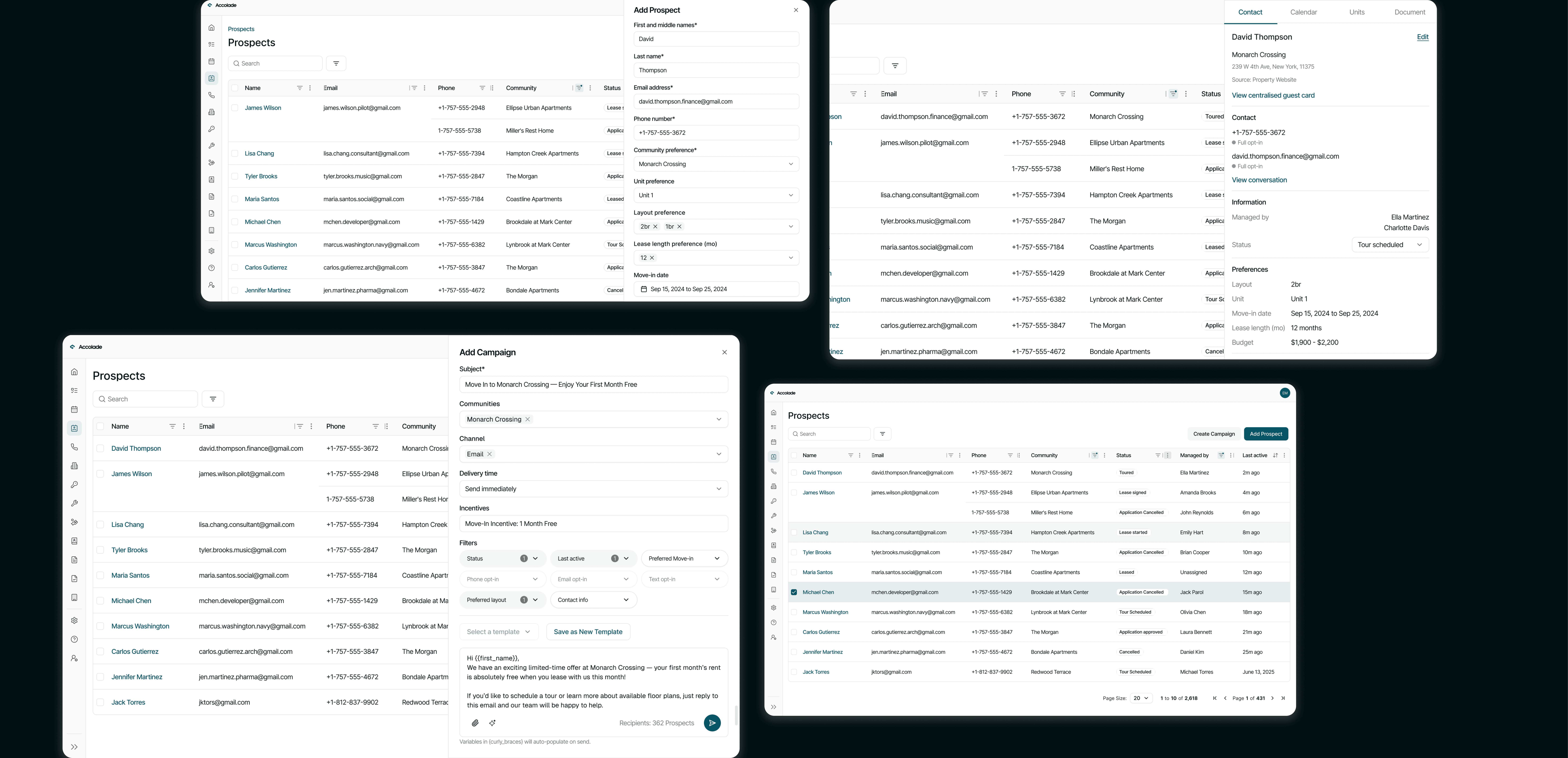
Together, we built an AI-native real estate operations platform that brought conversations, AI assistance, tours, guest cards, tasks, and human handoffs into a single experience. Instead of relying on disconnected tools and manual processes, leasing teams could manage the entire prospect journey in one place.
The decisions we made during Prospect Management became the foundation for later parts of the platform. As new modules were introduced, the design system grew alongside them, reusable patterns emerged, and many of the workflows extended naturally into Resident Management and other shared platform experiences.
Impact
• Helped shape the product from 0 to 1 alongside Product Managers and engineers.
• Designed the leasing journey from prospect to resident.
• Co-authored PRDs and helped define product behavior before moving into design.
• Built reusable patterns that later supported other modules across the platform.
• Stayed involved through design, reviews, and implementation as the product evolved.


